
Do You Really Need Winter Tires?

Do You Really Need Winter Tires?

Long answer short, in the harsh Canadian winters, we strongly recommend that you invest in a good set of reliable winter tires. Winter tires have been proven to provide better traction on the road when the temperature averages 7 degrees Celcius or colder. When it comes to the safety of yourself and your family, be sure you are prepared for the coming icy and snowy roads. 

When you look at a tire, it’s actually composed of two main parts: 

  • Tire: the black rubber doughnut
  • Wheel or rim: the circular metal structure that the tire wraps around

You have two options when buying winter tires: buy only the rubber tires and have them swapped onto your car’s existing rims, or buy winter tires that come with their own rims.

If you choose to purchase only the rubber tires, you can save money on the purchase but you’ll need to spend a little extra money and time getting the rubber swapped out on your rims.

If you prefer buying winter tires with their own rims, it’ll be quicker and easier to replace the tires (you might even be able to do it yourself), but you’ll need to pay extra for the rims. 

What is the difference between Summer and Winter tires?

The Difference Between Winter And All Season Tires

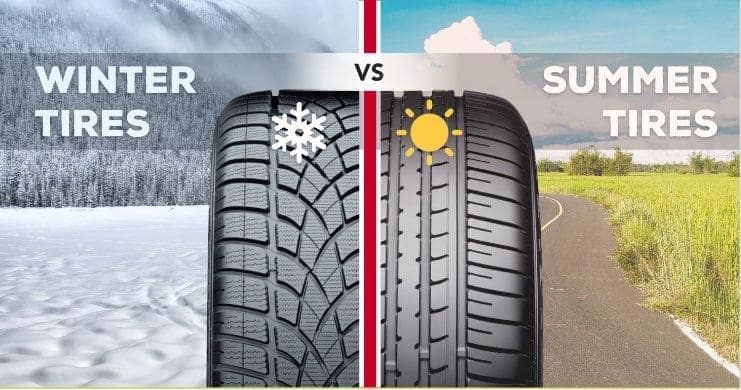
Summer tires have a dedicated rubber compound that delivers excellent grip and handling on both dry and wet roads in warmer conditions. They also have reduced rolling resistance and therefore provide greater fuel efficiency and generate less road noise.

The tread pattern on a summer tire is more streamlined than a winter tire, with fewer grooves for water clearance, maximizing the contact patch with the road. Consequently, the vehicle has superior traction and braking during dry summer months.

On the other hand, The tread compound of a winter tire contains more natural rubber, so it doesn’t harden when the temperature drops below 7 degrees Celsius. Instead, it stays flexible and limber in cold climates to reduce the stopping distance when braking.

The tread design has deeper blocks that will dig into snow and ice to provide more grip. The winter tire also has a lot of sipes, which are excellent for clearing water and slush from the path of the car and mitigating the risk of hydroplaning.

Winter tires shouldn’t be used for the summer season. The compound is far too soft for dry asphalt, meaning it will wear out quicker. Moreover, the increased rolling resistance will lead to higher fuel consumption and road buzz.

It’s important to remember that your Nissan’s driving features like 4-wheel drive (4WD), anti-lock brakes, and electronic stability control can be useful for accelerating and maneuvering, but they do almost nothing for stopping or slowing down. To get better traction on a snowy or icy road, there’s no substitute for winter tires.

Don’t wait too late into the winter season before pulling the trigger on your winter tire purchase. We receive the majority of our winter tire inventory in the autumn. While we always strive to have an incredible selection for our customers to choose from, options of tires can become limited as time goes by.

2026 Nissan Sentra: Conquer The 404 Commute
plus

2026 Nissan Sentra: Conquer The 404 Commute

The 2026 Sentra vs. The 404 Commute: Fuel Efficiency that Matters Anyone who drives the "Markham Crawl" knows that the Highway 404 commute isn’t just a drive—it’s a daily test of your patience and your paycheck. Whether you’re heading south toward the DVP or navigating the 407 interchange, you need a vehicle that handles stop-and-go gridlock without draining your bank account. At the time of...

Read more link-icon
Convenience At Your Finger Tips: 2026 Nissan Sentra Technology For A Modern Commute
plus

Convenience At Your Finger Tips: 2026 Nissan Sentra Technology For A Modern Commute

At Village Nissan, our team is witnessing a technological evolution in the compact sedan segment, and we want you to see it too! The redesigned 2026 Nissan Sentra has arrived, and it is packed with digital features and safety systems that make navigating the bustling streets of the Greater Toronto Area easier than ever. Whether you are commuting from the tech hubs near Highway 7 and Woodbine...

Read more link-icon
All-New Plug-in Hybrid Rogue Coming Soon
plus

All-New Plug-in Hybrid Rogue Coming Soon

The 2026 Nissan Rogue Plug-in Hybrid is making waves as Nissan’s first plug-in hybrid in Canada. It’s built with today’s families in mind, offering up to 61 km of all-electric range for those daily trips around town. Plus, with its hybrid powertrain, you can cruise up to 687 km, blending the ease of electric with the reliability of gas. "The Rogue Plug-in Hybrid is an important step in Nissan's...

Read more link-icon